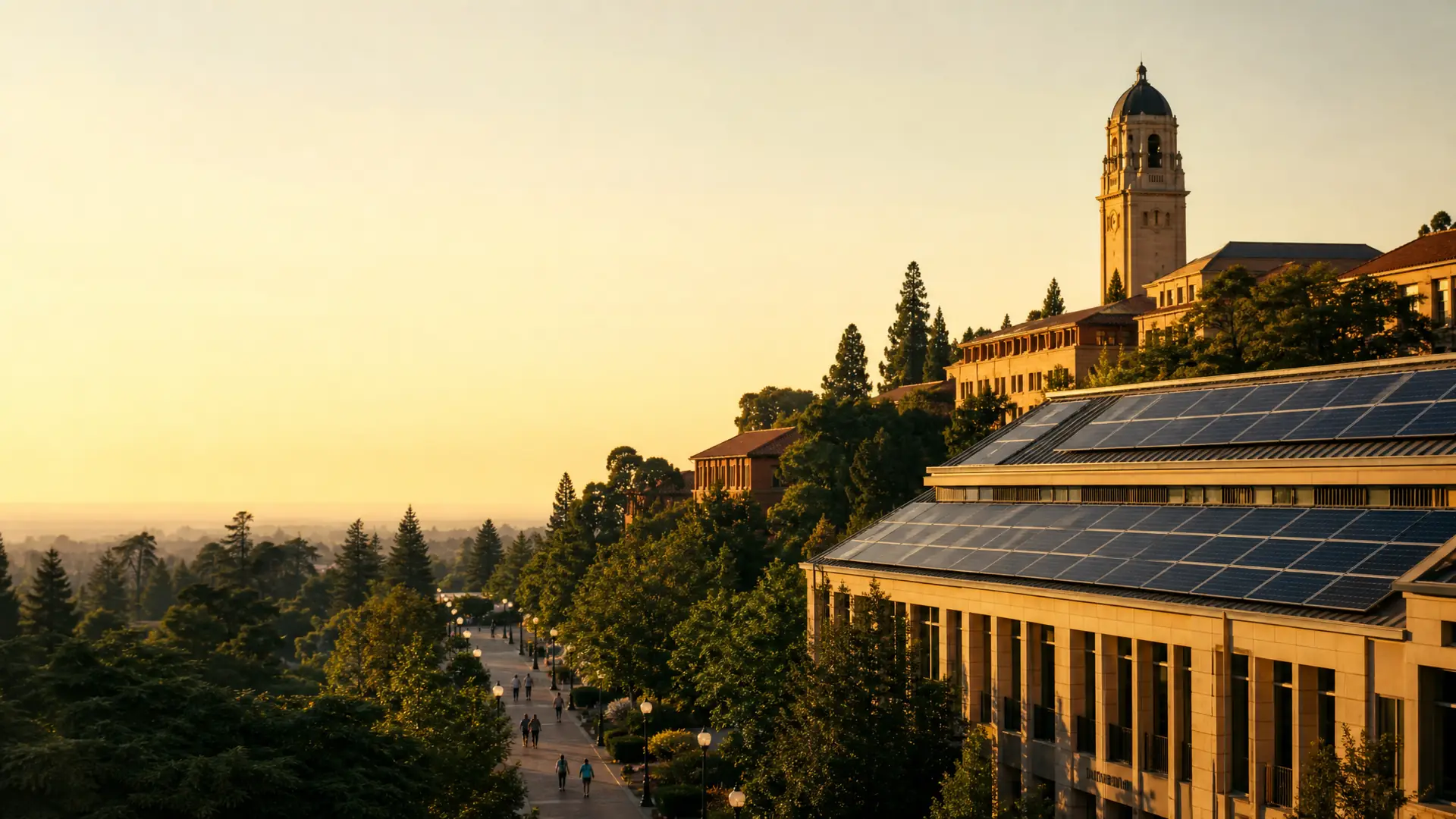
University campus at golden hour with solar panels on rooftops

Northgate University

Facilities & Sustainability · Project Proposal

Powering the campus
with the sun.

A 2.4 MWp photovoltaic program to cut electricity costs, secure supply, and anchor the university's 2035 net-zero commitment.

Explore the proposal Prepared for the Capital Approval Committee · March 2026
Northgate University · Campus Solar Initiative Est. first power · Q1 2028

Executive summary

The case for approval,
in four numbers.

0MWp Rated capacity — rooftops, carports & ground array
0GWh/yr Clean electricity generated — 26% of campus load
$0k/yr Estimated savings on electricity — payback under 9 years
0t CO₂/yr Carbon avoided — the largest single step to net-zero 2035

One integrated program: 2.4 MWp of photovoltaic generation, 1.5 MWh of battery storage, and a campus-wide monitoring lab. Estimated capital cost $4.8M — offset by a state clean-energy grant and the federal investment tax credit. All figures are preliminary engineering estimates.

Project objectives

Five goals, one program.

Cut electricity costs

~$520k in annual savings and a payback under nine years, with a 25-year savings stream of roughly $13M.

01 · Financial
Renewable supply

Meet 26% of campus electricity from the sun — the university's single largest renewable generation asset.

02 · Energy

A living laboratory

Engineering, data-science and sustainability curricula run directly on the array's live generation data.

03 · Education

Resilience

1.5 MWh of battery storage keeps research buildings and the data center online through grid events.

04 · Reliability

Net-zero 2035

This initiative delivers ~1,950 tCO₂ avoided per year — roughly a third of the remaining gap on the university's net-zero roadmap.

05 · Climate

Why now

The economics have
turned in our favor.

  • 4.1%

    Rate escalation — campus electricity rates have risen 4.1%/yr since 2018, compounding the value of every kWh we generate.

  • $800k

    State clean-energy grant — available now, allocated on a first-approved basis.

  • 30%

    Federal ITC — the investment tax credit is at its current level; a full program qualifies.

  • 2035

    Net-zero commitment — delaying a year pushes the target out of reach without buying expensive offsets.
Campus electricity rate, index (2018 = 100)
2018 2026 +38%
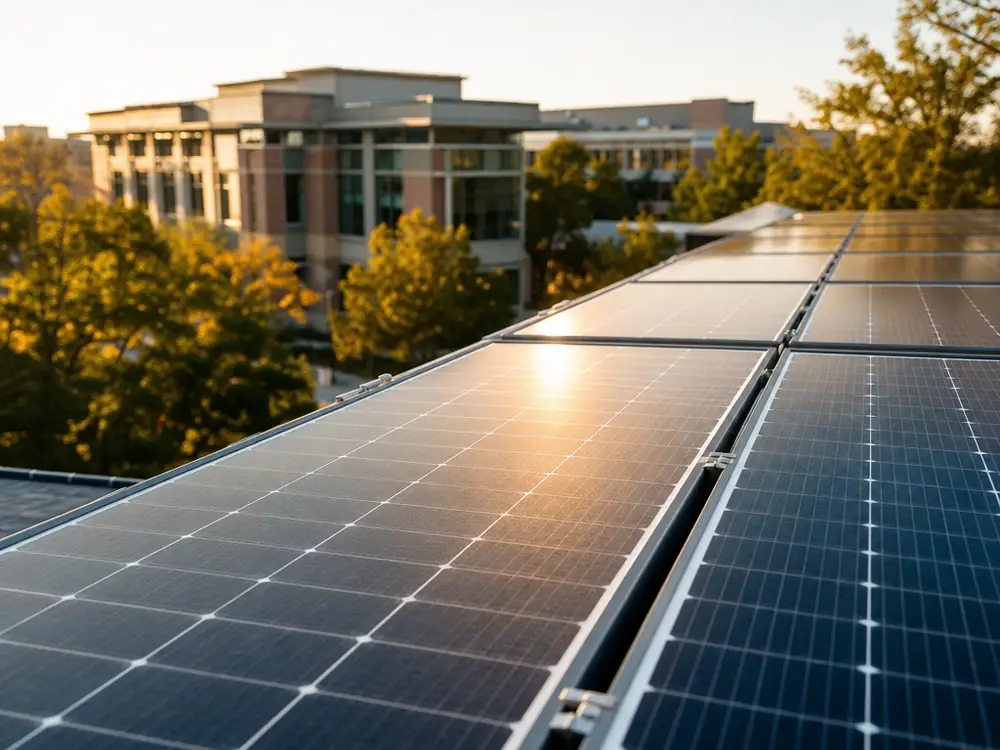
Close-up of solar panels on a university rooftop with campus buildings in the background
Rooftop array — Building 4, East campus

Scope & site

Where the sun lands.

4,800modules · 500 Wp bifacial
14,200 m²rooftops + 2 carports + ground array
12inverters · 200 kW string
1.5 MWhbattery storage · island-capable
25 yrperformance warranty · 0.45%/yr degradation
Livemonitoring + weather station · curriculum API

Siting follows a 2025 feasibility study of 22 buildings — the five selected roofs, two carports and one ground parcel maximize yield with zero impact on green space or athletics fields.

Estimated budget

$4.8M, engineered
line by line.

PV modules & racking
$1.62M
Construction & engineering
$1.19M
Inverters & electrical
$0.91M
Battery storage · 1.5 MWh
$0.69M
Soft costs · permits, studies, grid
$0.39M
Total estimated capital $4.8M · ≈ $2.00 / Wp

Funding stack

State clean-energy grant$800k
Federal ITC · 30%$1.44M
University capital budget$1.16M
Net university outlay$1.16M

Payback on the net outlay: ≈ 2.2 years of savings. The remainder is carried as a funded energy-services agreement.

Implementation timeline

Eighteen months
to first power.

Milestone — first power: Month 18 (Q1 2028). Construction is scheduled around the academic calendar; rooftop work runs through the summer window to keep campus disruption near zero.

Energy & savings

What the sun
delivers, yearly.

Monthly generation, MWh (est.)
JanJulDec ≈ 3.1 GWh/yr
0MWh/yr Generated on campus — sold first to the university, surplus to the grid
$0M / 25 yr Cumulative savings at 2% rate escalation, net of O&M
Cumulative net position, $M
payback ≈ yr 9 0 Yr 1 Yr 25

Environmental benefits

Measured in carbon,
water and air.

0t CO₂/yr ≈ 48,800 tonnes avoided over 25 years — the grid mix we displace, per EPA eGRID factors.
0homes/yr Equivalent annual electricity use of ~290 average households powered by the sun.
0cars/yr Emissions equal to taking ~420 passenger cars off the road every year.
0M gal/yr Cooling water avoided at thermal plants — ~1.9 million gallons each year.

Beyond the numbers: a visible climate commitment for students, faculty and donors — the array becomes the campus's public face of the 2035 net-zero pledge.

Financial return

A project that pays
for itself.

≈ 9.0 yr Simple payback on gross capex
≈ 2.2 yr Payback on net university outlay
≈ 11% Internal rate of return · 25 yr
$2.4M Net present value @ 5% discount

Assumptions: 2026 US$ · 2%/yr rate escalation · 0.45%/yr degradation · $18/kW-yr O&M · 1% annual inflation on operating costs. Sensitivities reviewed in Appendix B — the project remains NPV-positive down to a 20% tariff discount and a 10% cost overrun.

Risks & mitigation

We priced the
things that could go wrong.

RiskMitigation
Intermittent generation 1.5 MWh storage + grid-export agreement + demand-shifting of campus loads to solar hours.
Cost overrun Fixed-price EPC contract · 10% contingency line · phased funding gates tied to design completion.
Campus disruption Rooftop work confined to the summer window; logistics plan approved by Campus Operations; zero green-space impact.
Long-term performance 25-yr performance warranty (0.45%/yr) · 10-yr O&M contract · live monitoring with alert thresholds.
Policy / tariff shift ITC and grant are locked at contract signature; rate risk is hedged by the escalation assumption and 20-yr PPA backstop.

Recommendation

Approve the Campus
Solar Initiative.

$4.8M program · 26% renewable supply · under 9-year payback · 1,950 t CO₂ avoided each year. The sun is the cheapest energy the university will ever sign.

01

Approve funding · Q2 2026

02

Finalize design & PPA · Q4 2026

03

Construct · summer 2027

04

First power · Q1 2028

Facilities & Sustainability · [email protected] · Prepared with Loom — AI-assisted project development

← → to navigate · F for fullscreen